
Florida Summary Administration: The New $150,000 Limit
Short answer
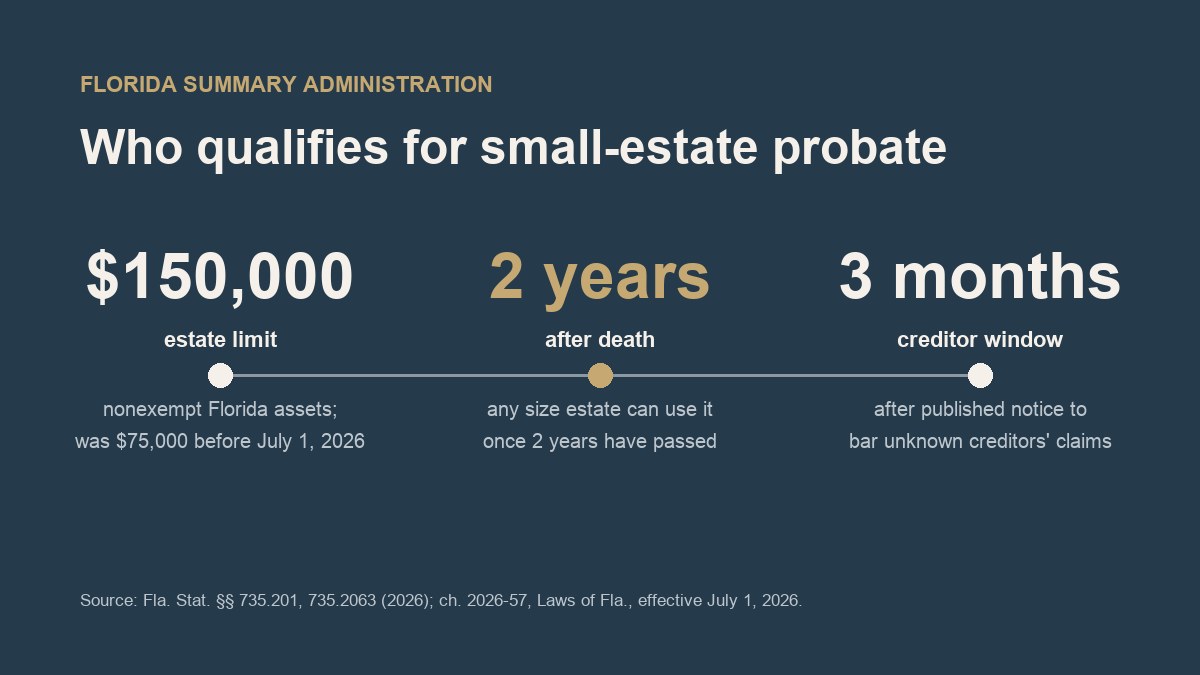
Florida summary administration is a shortened probate where the court orders assets distributed without appointing a personal representative. Under Fla. Stat. § 735.201, it is available if the will does not require formal administration and the Florida estate, less exempt property, is $150,000 or less (up from $75,000 on July 1, 2026) or the death was over 2 years ago.
General information only. Laws and deadlines depend on the state and the facts. This is not legal advice. See the disclaimer.
Key points
- Since July 1, 2026, the value limit is $150,000 of nonexempt Florida probate assets, double the old $75,000.
- If the decedent died more than 2 years ago, summary administration is available regardless of the estate's size.
- Before the order, known creditors must be found and served, and people who receive property can remain liable for valid debts.
What is summary administration in Florida?
Florida law offers two main ways to probate an estate: formal administration, in which the court appoints a personal representative who gathers assets, pays debts and later distributes what is left, and summary administration under Part II of Chapter 735. In summary administration, no personal representative is appointed. The court reviews a sworn petition and, under § 735.206, may enter an order allowing immediate distribution of the assets to the people entitled to them.
Banks, brokerages and others holding the decedent's property can then pay or transfer it to the people named in the order, and § 735.206(4)(b) says they are not accountable to anyone else once they do. Summary administration can be used for the estate of a Florida resident or a nonresident who left property in Florida. It is a court proceeding, so it still involves a filing with the circuit court clerk in the county where the case belongs and a judge's order.
Who qualifies for summary administration in Florida?
Under § 735.201, summary administration is available when both of these are true:
- If there is a will, it does not direct administration under Chapter 733 (formal administration).
- The value of the entire estate subject to administration in Florida, less property exempt from creditors' claims, is $150,000 or less, or the decedent has been dead for more than 2 years.
What changed in 2026?
Chapter 2026-57, Laws of Florida (CS/HB 1337), raised the summary administration limit in § 735.201 from $75,000 to $150,000. The act was approved by the Governor on April 29, 2026 and took effect July 1, 2026. The same law raised several other small-estate thresholds:
- Bank accounts: under § 735.303, a Florida bank may pay a decedent's qualified accounts to a family member, with no court case, if they total $2,000 or less (up from $1,000). The bank may not pay earlier than 6 months after the death.
- Federal tax refunds: under § 735.302, an overpayment of up to $5,000 (up from $2,500) may be refunded to a surviving spouse or a designated child on a verified application.
- Small intestate estates: under § 735.304, no administration is required when a person died without a will more than 1 year ago leaving only exempt personal property and nonexempt personal property worth no more than $20,000 (up from $10,000) plus preferred funeral expenses and certain final medical costs.
How do you count the $150,000?
The test looks only at the estate subject to administration in Florida, minus property exempt from creditors' claims. Assets that pass outside probate, such as accounts with a named beneficiary or payable-on-death designation, property held jointly with right of survivorship, and assets titled in a living trust, generally are not part of the probate estate. That means a person whose total wealth is well above $150,000 can still leave a probate estate that qualifies.
Property that is exempt from creditors, which can include a Florida homestead protected by the state constitution and certain exempt personal property under § 732.402, is subtracted before comparing against the limit. Whether a particular home or item is exempt can be a contested legal question, so it is worth confirming before you rely on it. The act took effect July 1, 2026; if the death occurred earlier, ask a Florida probate lawyer which limit the court will apply to your filing.
Who files the petition and who has to sign?
Under § 735.203, any beneficiary, or the person nominated as personal representative in a will offered for probate, may file the petition. It must be signed and verified by the surviving spouse, if any, and the beneficiaries. A beneficiary who will receive a full distributive share under the proposed distribution does not have to join, but formal notice of the petition must be served on any beneficiary who does not join.
If one of those people has died, is incapacitated or is a minor, the petition is signed by that person's personal representative, guardian or, in some cases, the person they transferred their interest to. If there is a will, § 735.206(1) requires it to be proved and admitted to probate under Chapter 733 when the petition is filed. Under § 735.2055, a petition for summary administration can be filed at any stage of an estate, including after formal administration has started, if the estate would qualify at the time of filing.
What happens to the decedent's debts?
Summary administration does not erase debts. Before the court enters the order, § 735.206(2) requires the petitioner to make a diligent search and reasonable inquiry for known or reasonably ascertainable creditors, serve them with a copy of the petition, and make provision for paying them to the extent assets are available.
After the order, the people who received nonexempt property remain personally liable for a pro rata share of valid claims, up to the value they actually received, under § 735.206(4)(e). A known creditor who was not notified and not provided for can sue those who joined in the petition and, if it wins, recover attorney's fees. Under § 735.2063, anyone who obtained the order may publish a notice to creditors; once proof of publication is filed, claims of unknown creditors are barred unless filed within 3 months after the first publication. And under § 735.206(4)(f), no claim can be enforced against the estate or recipients more than 2 years after the death unless proceedings to enforce it have started.
How much does summary administration cost in Florida?
The court filing fee is set by § 28.2401: up to $340 for summary administration of an estate valued at $1,000 or more and $230 for an estate under $1,000, plus a $4 service charge on the petition (as checked November 28, 2026). Formal administration carries a filing fee of up to $395. There may also be costs for certified death certificates, certified copies of the order and, if you choose to publish one, a notice to creditors. Attorney's fees are separate and vary.
Because the petitioner must handle creditor searches, notice to non-joining beneficiaries and proof of any will, many families work with a probate lawyer even for a small estate. Your county clerk's probate division can explain local filing requirements but cannot give legal advice.
When is formal administration the better choice?
Summary administration works best when the assets are simple, the beneficiaries agree and the debts are known. Formal administration may make more sense when someone needs authority to act for the estate over time, such as selling real estate before distribution, pursuing a lawsuit or collecting money owed to the decedent, when beneficiaries disagree, or when the will requires it. Section 735.202 lets an estate that qualifies for summary administration be administered formally instead.
This guide is general information about Florida law, not legal advice for your situation. For a broader overview, see what probate requires, whether a will avoids probate and what a beneficiary designation does. To talk through a specific estate, contact a Florida probate attorney through our estate planning page.
Questions people ask
What is the summary administration limit in Florida in 2026?
Since July 1, 2026, the limit is $150,000. Under Fla. Stat. § 735.201 as amended by chapter 2026-57, Laws of Florida, the estate subject to administration in Florida, less property exempt from creditors' claims, must not exceed $150,000, unless the decedent has been dead for more than 2 years.
Does a personal representative get appointed in summary administration?
No. The court enters an order of summary administration that assigns the assets directly to the people entitled to them, under § 735.206. People holding the decedent's property can then transfer it to those named in the order.
Can I use summary administration if there is a will?
Yes, as long as the will does not direct formal administration under Chapter 733. The will must be proved and admitted to probate when the petition is filed, under § 735.206(1).
Do creditors get paid in Florida summary administration?
They must be accounted for. The petitioner must search for known or reasonably ascertainable creditors, serve them with the petition and provide for payment to the extent assets are available. People who receive nonexempt property can remain liable for valid claims up to the value they received.