
What a Warranty Deed Does
Short answer
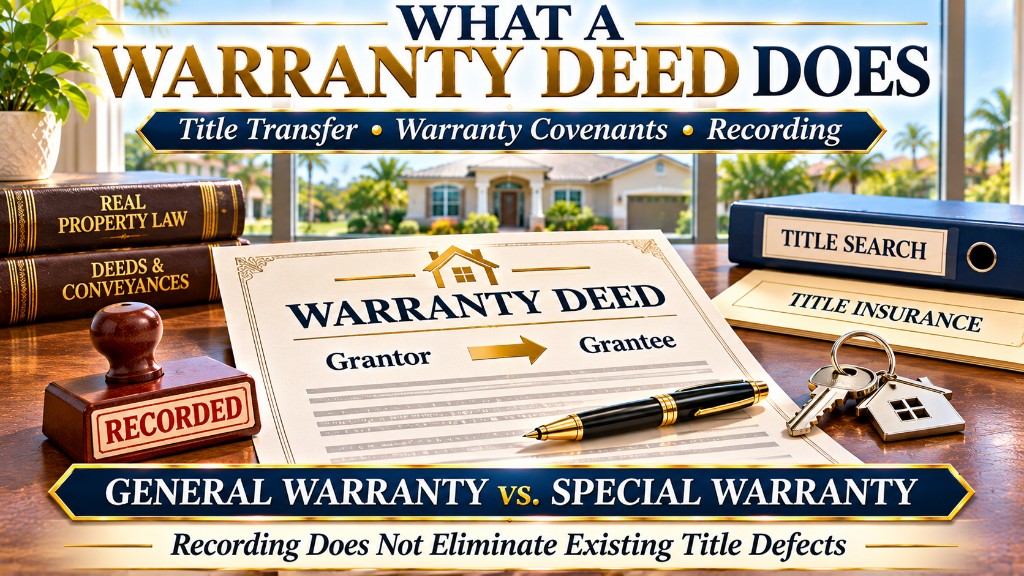
A warranty deed transfers title and includes covenants that the grantor warrants title against defects, at least to the extent the deed form covers. Names vary by state. A general warranty often reaches further back in the chain. A special warranty often limits those promises to the grantor's own period of ownership. It is not a quitclaim. Buyers and lenders usually require a warranty deed plus title insurance. Recording puts the deed in the public record. It does not erase every prior lien, missing signature, or other cloud. The form, the signatures, and the recording rules depend on the state where the land sits.
General information only. Laws and deadlines depend on the state and the facts. This is not legal advice. See the disclaimer.
Key points
- A warranty deed transfers title with covenants that the grantor warrants title, at least to the extent the form covers.
- It is not a quitclaim. Buyers and lenders usually still want a warranty form plus title insurance.
- A special warranty often limits the warranties to the grantor's period of ownership.
- Recording matters. It does not erase every defect in the chain.
What does a warranty deed actually do?
It conveys the grantor's title to the grantee and usually includes written promises about that title: that the grantor has the right to convey, that the title is free of undisclosed encumbrances the form covers, and that the grantor will defend against certain claims. The exact covenants, and the label on the form, depend on the state. The deed is the transfer paper. It is not the title policy.
The title examination and insurance guide is the longer page on the chain of title and the policy. What a title commitment shows is the exceptions list to read before anyone treats a deed as enough. This article is the warranty form buyers and lenders usually ask for.
- Who is named as grantor and grantee
- Whether the form is a general or special warranty
- The legal description on the deed
- Whether the deed was recorded in the right county
Is a warranty deed the same as a quitclaim?
No. A quitclaim transfers whatever interest the grantor has, without warranties that the title is clear. A warranty deed adds covenants about title, at least for the period and the defects the form covers. Calling a paper a deed does not add those warranties. Families sometimes use a quitclaim after a divorce or a gift. An arm's-length purchase usually needs the warranty form.
What a quitclaim deed does is that weaker transfer paper. Do not treat a quitclaim from a relative as the same closing package a purchase contract describes. What to check before a home closing is the deadline calendar that sits next to the deed and the commitment.
What is the difference between a general and a special warranty?
A general warranty often warrants title against defects arising before and during the grantor's ownership, subject to the form and the exceptions stated. A special warranty, sometimes called a limited warranty, often covers only defects that arose while the grantor owned the property. The labels and the statute language vary by state. Read the covenants on the draft before anyone signs.
The property transactions guide is the longer closing checklist. What earnest money does is the deposit held while that closing package is still open. Title insurance still sits beside either warranty form. The deed's covenants and the policy's covered risks are not the same promise.
Does recording the warranty deed finish every title problem?
Recording puts the deed in the public record so later buyers and lenders can find it. It does not erase every prior lien, judgment, or missing signature in the chain. An unrecorded deed can leave the next buyer or lender looking at an incomplete file. The county and the state control how the deed must be signed, notarized, and indexed.
What a quiet title case does is the court case that asks to clear a recorded cloud when a deed alone is not enough. The real estate disputes guide is the longer page when the recorded chain and the parties' story do not match. Do not skip the title commitment because someone promised a warranty deed.
Who can explain a warranty deed before someone signs it?
The Best Lawyer Around publishes these guides and can request an introduction to an independent attorney. It is not a law firm, and reading this article does not create an attorney-client relationship. The attorney you speak with decides whether to take the matter and what the fee is.
If a closing or a recording deadline is this week, bring the draft deed, the title commitment, and the purchase contract. Do not wait on a website reply. The disclaimer and the questions about this site state the limits of these pages. Locations is the reminder that the land and the recording office may not be in the same place you live.
Questions people ask
What does a warranty deed do?
It transfers title and usually includes covenants that the grantor warrants title against defects, at least to the extent the form covers. It is the deed form buyers and lenders usually require in a purchase.
Is a warranty deed the same as a quitclaim?
No. A quitclaim transfers whatever interest the grantor has, without warranties of clear title. A warranty deed adds title covenants. They are different papers.
What is a special warranty deed?
A form that often limits the grantor's warranties to defects that arose during the grantor's own period of ownership. Labels and statute language vary by state. Read the covenants on the draft.
Do buyers still need title insurance with a warranty deed?
Usually yes. The deed's covenants and the title policy cover different risks. Buyers and lenders commonly require both a warranty form and title insurance.
Does recording the deed clear every title defect?
No. Recording puts the deed in the public record. It does not erase every prior lien, judgment, or break in the chain. The title commitment and the exceptions list still matter.
Does this page prepare or record a deed for me?
No. The Best Lawyer Around is not a law firm. Reading this article does not create an attorney-client relationship or transfer title.