
How Do You Request HOA Records in Florida?
Short answer
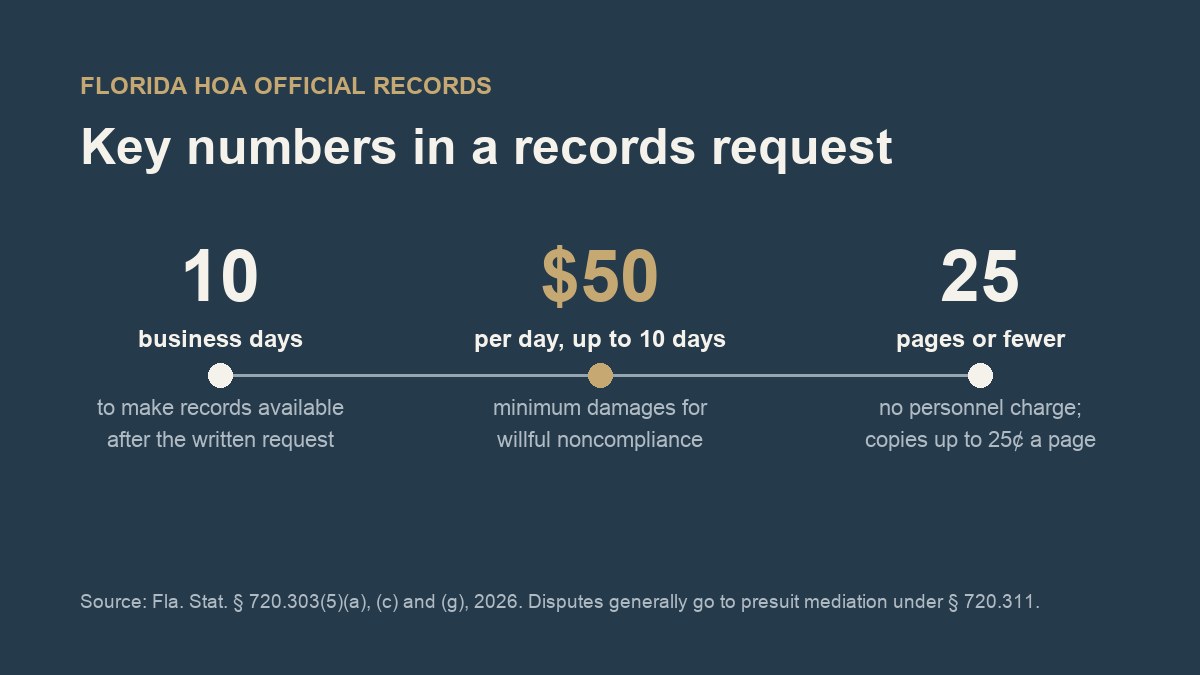
To request HOA records in Florida, send the association a written request to inspect or copy its official records. Under Fla. Stat. § 720.303(5), the HOA must make them available within 10 business days. If a certified-mail request goes unanswered, willful noncompliance is presumed and minimum damages of $50 a day, up to 10 days, can apply.
General information only. Laws and deadlines depend on the state and the facts. This is not legal advice. See the disclaimer.
Key points
- Make the request in writing; certified mail, return receipt requested, gives you the strongest record.
- The HOA has 10 business days to make records available and cannot demand a reason for your request.
- Some records stay private, and most records disputes require presuit mediation before a lawsuit.
How do you request HOA records in Florida?
Florida's homeowners' association law, Florida Statutes § 720.303, says the association's official records must be open to inspection by any member or the member's authorized representative, and that the right to inspect includes the right to make or get copies at a reasonable cost. Access is triggered by a written request from a parcel owner. The statute does not prescribe a form, so a short letter or email to the board or management company that names the records you want and asks for a time and place to inspect them is a common starting point.
Under § 720.303(5)(b), the association's failure to provide access within 10 business days after receiving a written request sent by certified mail, return receipt requested, creates a rebuttable presumption that it willfully failed to comply. A plain email still counts as a written request, but certified mail gives you proof of the date the clock started. Keep a copy of the request and the receipt. This guide covers homeowners' associations under Chapter 720; condominium associations follow a separate statute, Chapter 718, with its own rules.
Which HOA records can a member see?
Section 720.303(4) lists the official records the association must keep, generally for at least 7 years unless the governing documents require longer. They include:
- The declaration, articles, bylaws, every amendment and the current rules.
- Minutes of board and member meetings.
- Insurance policies and current contracts, including management agreements and leases.
- Financial and accounting records, such as receipts and expenditures, owner account ledgers, tax returns and financial statements.
- Plans, permits and warranties for common-area improvements.
- Voting records such as ballots, sign-in sheets and proxies, which must be kept at least 1 year after the election, vote or meeting.
- All other written records related to operating the association.
How long does an HOA have to provide records?
The association must make official records available for inspection or photocopying within 10 business days after the board or its designee receives the written request, under § 720.303(5)(a). The records must be available within 45 miles of the community or within the county where the association is located. The association can also comply by keeping copies in the community or by giving electronic access, such as posting the records online or letting you view them on a screen and print on request.
An association may adopt reasonable written rules on the frequency, time, location, notice, records and manner of inspection. Under § 720.303(5)(g), it may not require a member to show a proper purpose or give any reason for inspecting, and it may not limit inspection to less than one 8-hour business day per month. Associations with 100 or more parcels also had to post key documents, such as the governing documents, budget, financial report, contracts and meeting notices, on a website or app by January 1, 2025 under § 720.303(4)(b), so check your owner portal before you write.
How much can an HOA charge for copies?
Inspection itself is free. Under § 720.303(5)(a), you may use a smartphone, tablet, portable scanner or camera to copy records, and the association may not charge for that. If the association has a photocopier where the records are kept, it must provide copies during the inspection when the whole request is 25 pages or fewer.
For copies it makes, § 720.303(5)(g) lets the association charge up to 25 cents per page on its own photocopier. It may charge personnel costs for retrieving and copying only when the work takes more than half an hour, at no more than $20 per hour, and never for a request that results in 25 or fewer pages. For larger requests, or when no photocopier is on site, it may use an outside copy service and pass along the actual cost shown on the vendor's invoice (as checked November 27, 2026).
What HOA records are not open to members?
Section 720.303(5)(g) lists records that are not accessible to members. They include attorney-client privileged and work-product records until the related litigation ends; information obtained in approving a lease, sale or transfer of a parcel; guest-visit records in a gated community; personnel records such as payroll and health records (although written employment agreements and budget records showing employee pay are not protected); owners' medical records; and personal identifying information such as Social Security, driver license and credit card numbers, email addresses and phone numbers. Owners' names, parcel designations, mailing addresses and property addresses are not restricted.
Passwords and other data security measures, and the software used to manipulate data, are also exempt, though the data itself is part of the official records. If the association withholds something, it is reasonable to ask which exemption it is relying on.
What can you do if the HOA refuses to provide records?
Under § 720.303(5)(c), a member who is denied access to official records is entitled to actual damages or minimum damages for the association's willful failure to comply. Minimum damages are $50 per calendar day for up to 10 days, starting on the 11th business day after the association receives the written request. Separately, § 720.303(5)(d) makes it a second-degree misdemeanor for a director, board member or community association manager to knowingly, willfully and repeatedly violate the access rules with intent to harm the association or its members.
Before suing, read § 720.311. It lists disputes over access to the official records among those that must first go to presuit mediation, started by serving a demand in the statutory form by certified mail and first-class mail. The other side has 20 days to respond, and a party who refuses to take part may lose the right to recover attorney fees and costs later. Emergency court relief is still available where it is truly required. If you are also dealing with a fine, a lien or a demand from the association, see our guides on what to do if you receive a demand letter and what a mechanics lien does.
This guide is general information about Florida law, not legal advice. A Florida real estate or community association attorney can review your governing documents and the history of your request. See our real estate practice guide for more.
Questions people ask
Do I have to tell my Florida HOA why I want its records?
No. Section 720.303(5)(g) says the association may not require a parcel owner to demonstrate any proper purpose for inspection, state any reason for the inspection, or limit the right to inspect to less than one 8-hour business day per month.
Can I take photos of HOA records instead of paying for copies?
Yes. Under § 720.303(5)(a), the association must let a member or authorized representative use a smartphone, tablet, portable scanner or other technology to make an electronic copy, and it may not charge a fee for doing so.
Do the same rules apply to a Florida condo association?
No. Condominium associations are governed by Chapter 718 of the Florida Statutes, which has its own official-records provisions. This guide covers homeowners' associations under Chapter 720.
How long must a Florida HOA keep its records?
Most official records must be kept for at least 7 years under § 720.303(4)(a), unless the governing documents require longer. Voting records such as ballots and proxies must be kept at least 1 year after the election, vote or meeting.