
When Is the Florida Homestead Exemption Deadline?
Short answer
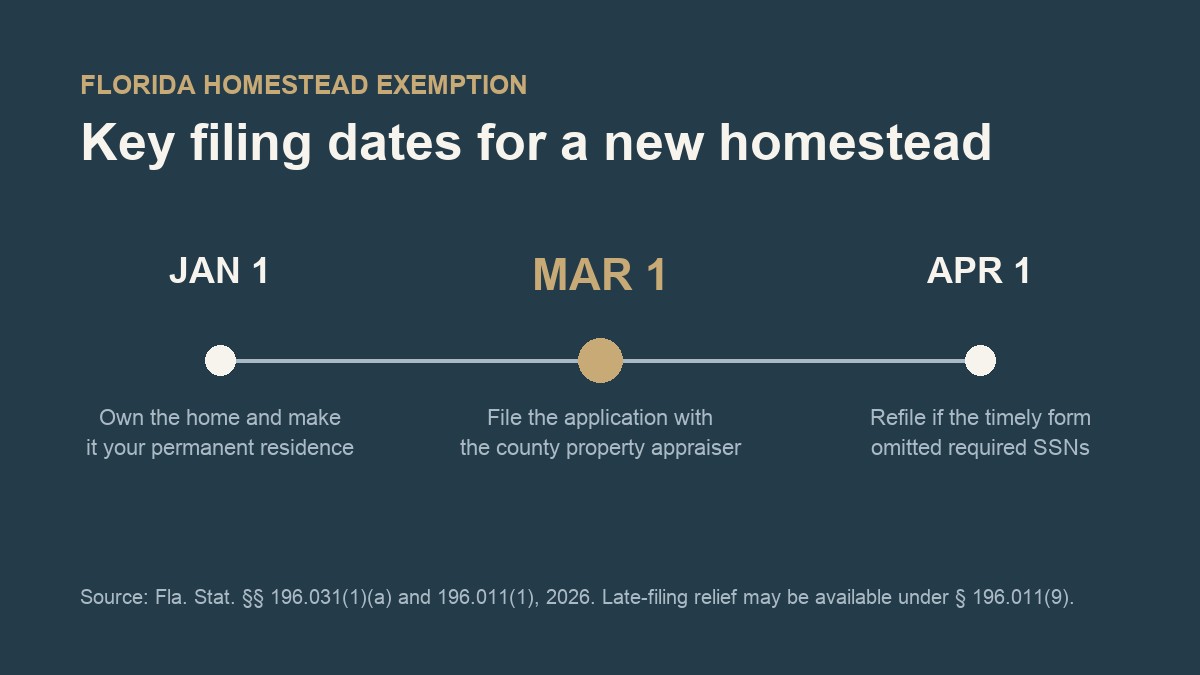
The Florida homestead exemption deadline is generally March 1. You must own the home and make it your permanent residence on January 1, then file with your county property appraiser by March 1 of that tax year. Missing it generally waives the exemption for that year, with narrow late-filing exceptions.
General information only. Laws and deadlines depend on the state and the facts. This is not legal advice. See the disclaimer.
Key points
- Ownership and permanent residence are measured on January 1.
- File with the county property appraiser by March 1.
- Late filing is possible only in limited circumstances, so do not count on it.
When is the Florida homestead exemption deadline?
Under Florida Statutes § 196.011, a person who owns property on January 1 that qualifies for an exemption must file an application with the county property appraiser on or before March 1. The statute says failing to apply by March 1 is a waiver of the exemption for that year, except for the postal-error and late-filing provisions discussed below.
For example, a fictional buyer who closes on a Florida house in November 2026 and moves in as a permanent residence before January 1, 2027 would generally look to file by March 1, 2027 for the 2027 tax year. A buyer who closes in February 2027 does not own the home on January 1, 2027, so the first year to claim it would generally be 2028. Check your county property appraiser’s website for its filing portal and any document checklist.
Who qualifies for a Florida homestead exemption?
Section 196.031 covers a person who, on January 1, holds legal or beneficial title to Florida real property and in good faith makes it their permanent residence, or the permanent residence of someone legally or naturally dependent on them. The deed or other ownership instrument must be recorded in the county’s official records before the exemption is granted, and the property appraiser may ask for more ownership documents.
Co-owners can share the exemption as their interests appear, but the statute caps the basic exemption at $25,000 per person and per dwelling. Someone receiving a residency-based property tax exemption or credit in another state is generally not entitled to the Florida homestead exemption. If the title is in a trust, an LLC or several names, ask the property appraiser or a Florida attorney how that affects eligibility before relying on it. Our guide to whether recording a deed proves ownership explains what the public record does and does not show.
How much does the homestead exemption reduce?
The first $25,000 of assessed value is exempt from all property taxes except special-benefit assessments. A second exemption of up to $25,000 applies to assessed value above $50,000, but not to school district levies, and § 196.031(1)(b) now adjusts that second $25,000 each January 1 for positive inflation. The Florida Department of Revenue describes the combined benefit as reducing taxable value by as much as $50,000 (as checked November 26, 2026).
Getting the exemption also brings the home under the Save Our Homes assessment limit. Under § 193.155, after the first exempt year, annual increases in the home’s assessed value are capped at the lower of 3% or the change in the Consumer Price Index, and the home is generally reassessed at full just value the year after a change of ownership. If you previously had a Florida homestead in any of the three preceding years, § 193.155(8) may let you transfer, or “port,” up to $500,000 of that assessment difference to the new home. Portability has its own application steps, so raise it when you file.
What if you miss the March 1 deadline?
Florida law leaves a narrow path. If you file a timely application but leave out the required Social Security numbers, § 196.011(1)(b) says the property appraiser will contact you and you may refile a complete application by April 1. If you can clearly document that a postal error caused the missed deadline, § 196.011(8) directs the value adjustment board to grant the exemption to an otherwise eligible applicant.
Otherwise, § 196.011(9) lets a qualified applicant file late, but no later than the 25th day after the property appraiser mails the notice required by § 194.011(1). The appraiser may grant it if you show you were unable to apply on time or other extenuating circumstances. If the appraiser does not, you may petition the value adjustment board within the same window and pay a $15 nonrefundable filing fee. Read any notice you receive closely, since the window is short.
Do you have to reapply every year?
Once an original exemption is granted, § 196.011(7) has the property appraiser mail a renewal application each year by February 1 and accept it as evidence of the exemption unless it denies the application. Follow your county’s renewal instructions, watch your mail, and tell the property appraiser if you rent the home, move out or change the title, because the exemption depends on ownership and permanent residence continuing.
If you are buying or selling, see our home closing checklist and our real estate practice guide. This guide is general information about Florida law, not legal or tax advice. A Florida real estate attorney or your county property appraiser can address your specific facts.
Questions people ask
Can I apply for the Florida homestead exemption right after closing?
Eligibility is measured on January 1, and the application for that tax year is generally due by March 1. Counties set their own filing portals and accepted filing periods, so check your county property appraiser’s website for when it accepts applications for the coming year.
Does the homestead exemption transfer when I buy a new Florida home?
No. The exemption itself does not move with you. You apply again for the new home. If you had a Florida homestead within the three preceding years, you may be able to port some or all of the Save Our Homes assessment difference, up to $500,000, under § 193.155(8).
Is there a fee to file a homestead exemption application?
The statute does not set a fee for the original application. A late applicant who petitions the value adjustment board under § 196.011(9) must pay a $15 nonrefundable filing fee.